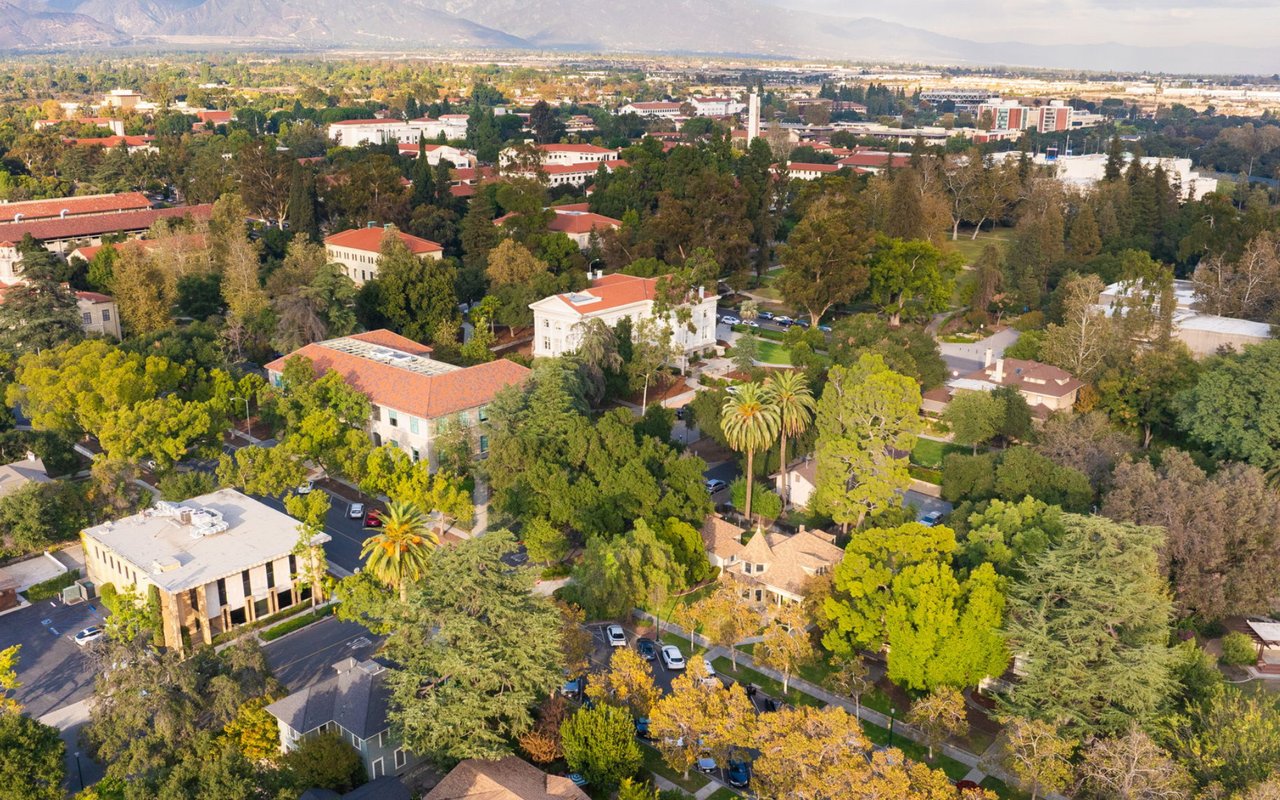
Drive down Foothill Boulevard on a fall afternoon and you will notice something unusual before you notice anything specific. The sidewalks are full of people carrying books. The coffee shops are loud with debate. Bicycles outnumber cars at every intersection near the center of town. This is Claremont, California, a city of roughly 37,000 people that happens to be home to seven independent institutions of higher education, all packed into an area of about one square mile.
Most cities with a college have one campus, one mascot, one homecoming weekend. Claremont has seven distinct institutions operating side by side, sharing a library, a health center, a security force, and a piece of open land set aside for field research, while each retains its own faculty, its own admissions office, and its own identity. Together they are known as The Claremont Colleges, and the arrangement is often called the Claremont group plan or, more informally, "the 7Cs." It is a structure almost no other American city has replicated at this scale, and it has shaped nearly everything about how Claremont looks, functions, and feels.
The colleges are not a backdrop to the city. They are woven into it. The Spanish Colonial Revival buildings along College Avenue set the architectural tone that many later homes and civic buildings in Claremont borrowed from. The Claremont Village, the historic downtown a short walk from several of the campuses, thrives in part because of the foot traffic generated by students, faculty, staff, and visiting scholars. The city's museums, its performing arts calendar, its public lectures, and even its restaurant scene reflect an unusually well-educated, intellectually engaged population. Claremont's nickname, "The City of Trees and PhDs," is not a marketing slogan invented by a chamber of commerce. It is a description residents came up with themselves, referring to the tens of thousands of trees planted along the town's streets since the 1880s and the outsized share of residents who hold doctoral degrees.
Understanding Claremont, whether you are a prospective resident, a parent visiting a student for the first time, an alum returning after decades away, or simply someone curious about how this particular corner of Los Angeles County came to be, means understanding how The Claremont Colleges came into existence and how they operate. That story begins in 1887, with a small group of Congregationalists and a very big idea about what a Western college could become.
The History of The Claremont Colleges
Pomona College, the founding institution of what would become The Claremont Colleges, was incorporated on October 14, 1887, by a group of Congregationalists who wanted to build "a college of the New England type" on the West Coast. The founders originally intended to locate the school near the city of Pomona, and classes began the following year in a rented five-room house known as Ayer Cottage. The name Pomona stuck even after circumstances forced a change in location. When a Southern California real estate boom collapsed in 1888, an unfinished hotel in the nearby townsite of Claremont, along with the surrounding land, was offered to the fledgling college. The trustees accepted, and Pomona College relocated to Claremont, where it has remained ever since. The college awarded its first diplomas to the Class of 1894.
By the early 1920s, Pomona's enrollment had grown to the point where its president, James A. Blaisdell, faced a genuine dilemma. He could allow the college to keep expanding, which risked diluting the close, personal character that had defined it from the start, or he could cap growth and turn away qualified students. Blaisdell proposed a third option, one inspired by Oxford and Cambridge. Rather than building one larger university, he envisioned a cluster of small, independent colleges sharing a library and other common resources, each retaining the intimacy of a small college while students and faculty collectively gained access to the range of offerings found at a much larger institution. In a 1923 letter to philanthropist Ellen Browning Scripps, Blaisdell described his hope for "a group of institutions divided into small colleges, somewhat on the Oxford type, around a library and other utilities which they would use in common," adding that this arrangement would preserve "the inestimable personal values of the small college while securing the facilities of the great university."
The consortium was formally incorporated on October 14, 1925, exactly thirty-eight years after Pomona's own founding, under the name "The Claremont Colleges." That same year, a gift from Ellen Browning Scripps funded the creation of a graduate school, which today is known as Claremont Graduate University. Scripps herself went on to endow a women's college the following year, and Scripps College opened in 1927. The idea drew national attention almost immediately. Educational historian Paul Monroe of Harvard wrote that the torch of learning had passed from Antioch and Athens to Rome and Alexandria, to Padua and Paris, to Oxford and Cambridge, to Harvard and Yale, to Columbia and Chicago, and finally, in the twentieth century, to "the Claremont Colleges of the West."
Growth continued steadily across the twentieth century. Claremont Men's College, founded in 1946 by returning World War II veterans and their instructors and later renamed Claremont McKenna College, became the third member of the consortium. Harvey Mudd College followed in 1955, chartered in memory of a mining engineer and philanthropist who had served for twenty-five years on the consortium's Board of Fellows. Pitzer College joined in 1963 as a college for women with an emphasis on the social and behavioral sciences, becoming coeducational in 1970. The seventh and most recent addition, Keck Graduate Institute, was established in 1997 with a fifty-million-dollar grant from the W.M. Keck Foundation, becoming the nation's first graduate institution dedicated exclusively to the applied life sciences.
Throughout this expansion, the city of Claremont grew up alongside the colleges rather than around them. The town, incorporated in 1907, organized itself deliberately to complement the campuses, planting street trees, preserving a walkable downtown core, and encouraging architectural styles that echoed the Mediterranean and Spanish Colonial influences found across the college grounds. Few American towns have such a direct, continuous relationship between the growth of their local economy and culture and the expansion of a single group of educational institutions.
What Makes The Claremont Colleges Unique?
The genius of the Claremont group plan is that it solves a problem most colleges never manage to solve: how to give students the close mentorship of a small liberal arts college without limiting them to the course catalog, faculty roster, or social scene of a single institution.
In practice, this means a student enrolled at any of the five undergraduate colleges can cross-register for classes at the other four, drawing from a combined course catalog of more than two thousand offerings each semester. A Pitzer student interested in a Harvey Mudd computer science course, or a Claremont McKenna student who wants to take a Scripps art history seminar, can generally do so without transferring or paying additional tuition. Athletics work on a similar principle of shared strength: Pomona and Pitzer compete together as the Pomona-Pitzer Sagehens, while Claremont McKenna, Harvey Mudd, and Scripps field joint teams as the Claremont-Mudd-Scripps Stags and Athenas, both groups competing in NCAA Division III.
The consortium's central services extend well beyond academics and athletics. The Claremont Colleges Library, commonly known as Honnold/Mudd Library, holds more than 3.4 million items, a collection ranked among the largest of any private institution in California, trailing only Stanford and USC. Students across all seven institutions also share dining options, health and counseling services through the Tranquada Student Services Center, campus safety services, a bookstore, and a chaplaincy office, all coordinated by The Claremont Colleges Services, the nonprofit entity that manages consortium-wide operations.
This shared infrastructure is paired with intercollegiate academic departments that no single small college could support on its own, including programs in Chicano studies, Asian American studies, Africana studies, religious studies, media studies, and women's studies, each staffed by faculty drawn from multiple campuses. Pitzer and Scripps go a step further, jointly operating a single Department of Natural Sciences.
Governance remains genuinely independent at each institution. Every college in the consortium admits its own students, hires its own faculty, sets its own tuition, and grants its own degree, and each has developed a distinct academic personality over the decades, from Claremont McKenna's focus on government and economics to Pitzer's emphasis on social responsibility and environmental sustainability. What ties the seven together is a shared belief, dating back to Blaisdell's original 1923 letter, that a federation of small colleges can deliver both the intimacy of a boutique liberal arts education and the depth of resources typically reserved for large research universities.
The Individual Colleges of The Claremont Colleges
Pomona College
History. Pomona College is the founding member of The Claremont Colleges and the oldest institution in Claremont. Incorporated in 1887 by a group of Congregationalists hoping to recreate a New England-style college on the West Coast, Pomona held its first classes in 1888 in a small rented house before relocating to Claremont later that year, when an unfinished hotel and surrounding land were offered to the fledgling institution amid a collapsing real estate market. It was Pomona's own president, James A. Blaisdell, who first proposed the idea of a consortium of colleges in the 1920s, making Pomona not just the oldest school in Claremont but the intellectual originator of the entire group plan.
Academic Focus. Pomona is a four-year undergraduate liberal arts college offering 48 majors across the arts, humanities, social sciences, and natural sciences, along with access to roughly 650 of its own courses and more than 2,000 additional courses across the consortium. The college is known for a broad, exploratory curriculum with few required courses outside general breadth requirements, allowing students significant latitude in shaping their own academic paths.
Campus. Pomona's 140-acre campus sits at the western edge of the consortium, adjacent to the Claremont Village. Its architecture blends early Mission Revival buildings with later Spanish Colonial and modern structures, organized around a central academic quad. The campus is home to Bridges Hall of Music, a longstanding architectural landmark, and to notable public artworks including José Clemente Orozco's 1930 mural "Prometheus" and James Turrell's site-specific work "Dividing the Light." The Benton Museum of Art, Pomona's teaching museum, houses roughly 18,000 to 20,000 objects, including Italian Renaissance panel paintings from the Samuel H. Kress Foundation and a first-edition print series by Francisco Goya, and moved into a newly built 33,000-square-foot facility designed by Machado Silvetti and Gensler at the edge of the Village.
Notable Alumni or Contributions. Pomona has produced an unusually deep bench of visual artists, including James Turrell, Chris Burden, Helen Pashgian, Marcia Hafif, and Peter Shelton, several of whose works are held in the Benton's permanent collection. Film director Frank Capra graduated from Pomona in 1918, and the college's alumni network spans government, science, and the arts.
Claremont Graduate University
History. Claremont Graduate University traces its founding to 1925, the same year the broader consortium was incorporated, making it the second institution in Claremont and the first graduate school established under Blaisdell's group plan. Originally known simply as Claremont College, it went through several name changes over the following decades, becoming Claremont University College in 1961, Claremont Graduate School and University Center in 1962, and finally Claremont Graduate University in 1997, reflecting its increasing focus on doctoral-level scholarship.
Academic Focus. CGU is exclusively a graduate institution, offering master's and doctoral degrees across roughly thirty disciplines organized into schools covering the arts and humanities, behavioral and organizational sciences, community and global health, management, education, information systems, politics and economics, botany, religion, and mathematical sciences. Its Peter F. Drucker and Masatoshi Ito Graduate School of Management, named for the influential management theorist who taught at CGU for more than three decades, is among its best-known programs.
Campus. CGU's buildings are interspersed throughout central Claremont rather than concentrated on a single contiguous campus, reflecting its role as a graduate-focused institution serving students and faculty across the consortium. CGU is closely affiliated with the California Botanic Garden, formerly the Rancho Santa Ana Botanic Garden, an 86-acre living collection of California native plants that also serves as the home of the university's Botany Department.
Notable Alumni or Contributions. CGU has graduated more than 23,000 alumni since its founding and describes its academic approach as transdisciplinary, encouraging scholarship that deliberately crosses traditional departmental boundaries. Its research institutes contribute regularly to policy and organizational scholarship used well beyond Claremont.
Scripps College
History. Scripps College was founded in 1926 by newspaper publisher and philanthropist Ellen Browning Scripps, who considered it, in her own words, her "crown jewel" among a lifetime of educational and scientific giving that also included the Scripps Institution of Oceanography and the Scripps Clinic. Scripps opened its doors in 1927 as the second undergraduate college in the consortium and remains the only women's college among The Claremont Colleges today. Ellen Browning Scripps envisioned an institution that would educate women "to think logically, weigh evidence, and, as far as possible, to seek the truth," and that founding language still informs the college's academic identity.
Academic Focus. Scripps offers a rigorous interdisciplinary curriculum anchored by its Core Curriculum in Interdisciplinary Humanities, a sequence of courses that runs through a student's first two years and asks students to examine culture, history, and society from multiple methodological angles before they specialize. The college maintains a roughly 10:1 student-to-faculty ratio and is particularly known for programs in the humanities, the arts, and, through its shared Department of Natural Sciences with Pitzer College, the sciences.
Campus. Scripps's campus is frequently cited as one of the most architecturally cohesive and beautiful among the seven colleges, built in a Mediterranean and Spanish Colonial Revival style organized around courtyards, fountains, and formal gardens. The campus is listed on the National Register of Historic Places. The Scripps motto, "Incipit Vita Nova," drawn from Dante and translating to "Here begins new life," is inscribed throughout the grounds.
Notable Alumni or Contributions. Scripps has built a reputation for graduating leaders in the arts, education, and public life, and its architecture and gardens remain among the most visited and photographed spaces in Claremont, drawing visitors well beyond the college community.
Claremont McKenna College
History. Claremont McKenna College opened in September 1946 as Claremont Men's College, the third institution in the consortium, with an entering class of 86 students and seven faculty members, many of them returning World War II veterans attending on the GI Bill. The college was incorporated the following spring and set out with a clear purpose: to prepare graduates for leadership in business, government, and public affairs through a rigorous liberal arts curriculum grounded in what its founders called the "Original Idea," a rationally balanced education addressing the political, economic, social, and cultural needs of the postwar world. The college admitted its first women in 1976 and was renamed Claremont McKenna College in 1981 in honor of founding trustee Donald McKenna.
Academic Focus. CMC is known for its concentration in economics, government, international relations, and public policy, alongside a full liberal arts curriculum in the sciences and humanities. The college operates eleven research institutes and centers, including the Rose Institute of State and Local Government, giving undergraduates access to faculty collaboration and research opportunities more typical of a graduate program. Nearly three-quarters of CMC students participate in research alongside faculty before graduating.
Campus. CMC's 69-acre campus sits near the eastern edge of the consortium. The Marian Miner Cook Athenaeum, which hosts the college's well-known speaker series, remains a central gathering point for both students and the broader Claremont community. The Kravis Center, an academic building designed by architect Rafael Viñoly and completed in 2011, was funded by a $75 million gift from alumnus Henry Kravis, co-founder of the investment firm Kohlberg Kravis Roberts.
Notable Alumni or Contributions. Henry Kravis, one of the most prominent figures in American private equity, is among CMC's best-known alumni, and the college's Robert Day School of Economics and Finance, established in 2007, has become a significant hub for CMC's applied economics scholarship.
Harvey Mudd College
History. Harvey Mudd College was chartered on December 14, 1955, becoming the fifth member of the consortium, in memory of Harvey Seeley Mudd, a mining engineer who had chaired the consortium's Board of Fellows for twenty-five years but did not live to see the college he helped plan actually open. His widow, Mildred Mudd, contributed $250,000 toward its founding. The college opened its doors in September 1957, just weeks before the launch of Sputnik I, at a moment when the Cold War and the space race had made technical education a national priority. It was announced at the time as "a new college of liberal arts emphasizing basic science and engineering," a description the college still uses of itself today.
Academic Focus. Harvey Mudd offers four-year degrees in biology, chemistry, computer science, engineering, mathematics, and physics, along with interdisciplinary options such as mathematical biology and an Individual Program of Study for students who wish to design their own major. What distinguishes HMC academically is its insistence that roughly a third of every student's coursework come from the humanities, social sciences, and arts, a requirement rooted in the founders' belief that scientists and engineers must understand the human and societal impact of their work.
Campus. HMC's compact campus sits at the northern edge of the consortium, directly across the street from the Robert J. Bernard Field Station, giving science and engineering students unusually direct access to an outdoor research laboratory. The original campus master plan was designed by architects Edward Durell Stone and Earl Heitschmidt.
Notable Alumni or Contributions. Harvey Mudd has built a national reputation among liberal arts colleges of science and engineering, and its graduates are heavily represented in technology, research, and doctoral programs across the country. In recent national rankings of liberal arts colleges, Harvey Mudd has placed at or near the very top.
Pitzer College
History. Pitzer College was founded in 1963 as the sixth member of the consortium, named for citrus grower and philanthropist Russell K. Pitzer, a Pomona College alumnus who helped fund its creation. It opened as a residential college for women with a curricular emphasis in the social and behavioral sciences, hiring poet John W. Atherton as its first president. The founding class included 153 students from sixteen states and five countries. Pitzer became coeducational in the fall of 1970 and, from its earliest years, developed a reputation as the most pedagogically experimental of the undergraduate colleges, with students and faculty helping design its curriculum and system of governance from the start.
Academic Focus. Pitzer's mission centers on producing "engaged, socially responsible citizens of the world through an academically rigorous, interdisciplinary liberal arts education." The college organizes its academic identity around five core values: social responsibility, intercultural understanding, interdisciplinary learning, student engagement, and environmental sustainability. Pitzer allows students to design their own special majors in consultation with faculty advisers and has built a strong reputation in environmental science and sustainability studies.
Campus. Pitzer's motto, "Provida Futuri," meaning "mindful of the future," is reflected in its physical campus, which includes LEED-certified residence halls and a strong institutional commitment to sustainable building practices. Pitzer shares its Department of Natural Sciences with neighboring Scripps College.
Notable Alumni or Contributions. Pitzer has been repeatedly recognized in national rankings for its environmental programs and civic engagement, reflecting the founding values that have defined the college since its first graduating class in 1965.
Keck Graduate Institute
History. Keck Graduate Institute, known as KGI, is the seventh and newest member of The Claremont Colleges, established in 1997 through a $50 million grant from the W.M. Keck Foundation. It was founded by Henry E. Riggs, then president of Harvey Mudd College, who identified a gap between scientific research and its practical, commercial application and set out to build the first graduate institution in the United States dedicated exclusively to the applied life sciences. KGI awarded its first Master of Bioscience degree in 2002.
Academic Focus. KGI's programs integrate life and health sciences with business, engineering, pharmacy, and genetics, with a strong emphasis on industry partnerships, hands-on laboratory experience, and team-based capstone projects sponsored by bioscience companies. Its Master of Bioscience program requires a paid industry internship between a student's first and second years, and its academic offerings are now organized into schools of applied life sciences, pharmacy and health sciences, and medicine.
Campus. Unlike the other undergraduate campuses, KGI is located southwest of the Claremont Village rather than on the consortium's contiguous central campus, a result of a planning dispute in the early 2000s over an initially proposed site near the Bernard Field Station.
Notable Alumni or Contributions. KGI's applied, industry-facing model has produced several spinoff companies founded by its own students and faculty, and its advisory council has included prominent figures from biotechnology and the life sciences.
Shared Resources Across The Claremont Colleges
Few features illustrate the practical benefits of the consortium model as clearly as its shared academic and research infrastructure.
The Claremont Colleges Library. Known informally as Honnold/Mudd Library, the consortium's central library holds more than 3.4 million items, roughly a million of them physical volumes and the rest digital resources, making it one of the largest private academic library collections in California. Students at any of the seven institutions can access the full collection, and the library serves as a genuinely shared intellectual commons rather than a resource attached to any single college.
The Robert J. Bernard Field Station. Located on roughly 86 acres directly across the street from Harvey Mudd College, the Bernard Field Station functions as an outdoor laboratory for teaching and research in ecology and environmental science. It is one of relatively few field stations in the country located within easy walking distance of a college campus, and it supports over 170 species of birds, 250 species of higher plants, and more than 700 species of insects, along with a FLUXNET monitoring site used to study exchanges of carbon dioxide and other gases between the local coastal sage scrub ecosystem and the atmosphere.
Joint Athletic Programs. Pomona and Pitzer field combined teams as the Pomona-Pitzer Sagehens, while Claremont McKenna, Harvey Mudd, and Scripps compete jointly as the Claremont-Mudd-Scripps Stags and Athenas. Both groups compete in NCAA Division III as part of the Southern California Intercollegiate Athletic Conference, allowing students at smaller colleges to field competitive teams that would be difficult to sustain independently.
Museums and Performing Arts. The Benton Museum of Art at Pomona College anchors the consortium's visual arts offerings, with a collection of roughly 18,000 to 20,000 objects spanning Italian Renaissance painting to contemporary Southern California art. The Claremont Colleges also maintain a joint Five-College Theater Department, and the Sontag Center for Collaborative Creativity, known on campus as "the Hive," supports interdisciplinary creative work across all seven institutions.
Student Collaboration and Cross-Registration. Students take roughly 6,000 courses each year at a campus other than their home institution, about 16 percent of all courses taken across the consortium, and nearly 300 student clubs and organizations operate across the 5Cs, from a cappella groups and dance companies to the oldest college newspaper in Southern California, The Student Life.
The Colleges' Impact on Claremont
The economic and cultural footprint of The Claremont Colleges on the surrounding city is substantial and well documented. A 2018 economic impact study commissioned by the consortium estimated that The Claremont Colleges generated $706.8 million in regional economic activity during the 2016 to 2017 academic year, and the consortium employs approximately 3,600 people, making it one of the largest employers in the immediate area.
That economic presence shows up most visibly in the Claremont Village, the city's historic downtown, located just west of several of the campuses. The Village is a compact, walkable district of independent boutiques, art galleries, coffee shops, and restaurants, many of them family owned rather than part of national chains. A 2007 expansion added an art house cinema, a boutique hotel, and additional retail and office space on the site of a former citrus packing plant, extending the Village's footprint while preserving its street-level, pedestrian-oriented character. The steady flow of students, faculty, visiting scholars, and campus visitors gives Village businesses a level of consistent foot traffic that few small-town downtowns in Southern California can match.
The colleges' influence also shows up in Claremont's architecture and physical layout. The Spanish Colonial Revival and Mission Revival styles found across several campuses, most notably Scripps College's National Register-listed grounds, established an aesthetic vocabulary that later spread into the surrounding residential neighborhoods. Claremont's tree-lined streets, a defining feature of the city, trace back in part to an 1889 gift of 250 trees to the young townsite, a gesture explicitly intended to make Claremont feel like an established East Coast college town even in its earliest years. The city has since been recognized as a Tree City USA community for more than two decades running.
Culturally, the presence of the colleges supports an unusually active calendar of public events for a city of Claremont's size: gallery openings and exhibitions at the Benton Museum of Art, public lectures hosted through venues like Claremont McKenna's Marian Miner Cook Athenaeum, performances through the Five-College Theater Department, and educational programming at the California Botanic Garden. Historic preservation has also benefited from the colleges' presence, as institutional stewardship of older buildings on several campuses has helped anchor broader community interest in maintaining Claremont's older residential and commercial architecture. None of this happened by accident. It reflects more than a century of the colleges and the city developing in tandem, each shaping the character of the other.
Why The Claremont Colleges Matter Beyond Higher Education
The Claremont Colleges are known well beyond Southern California, and that reputation rests on more than admissions statistics. The consortium's research institutes, from CMC's Rose Institute of State and Local Government to CGU's Drucker School of Management, regularly produce scholarship that shapes public policy and business practice far outside Claremont. The California Botanic Garden, affiliated with Claremont Graduate University, holds the third-largest herbarium in the state and plays an active role in conserving rare and endangered California native plant species, work with direct relevance to conservation efforts across the American West.
The colleges also serve as a cultural resource for the broader region. Public lecture series, museum exhibitions, and concerts hosted across the seven campuses are open to the general public, not just to enrolled students, giving Claremont residents and visitors from neighboring cities regular access to programming that would typically require a trip into Los Angeles. The consortium's tradition of cooperation, described by the Fiske Guide to Colleges as "a collection of intellectual resources unmatched in America," has also influenced how other institutions think about inter-college collaboration, even though few have attempted to replicate the Claremont model at the same scale.
Perhaps most significantly, the colleges have functioned for a century as a training ground for people who go on to shape fields well outside academia, from the arts to business to public policy, a track record that keeps the Claremont name circulating in conversations far removed from the city itself.
Claremont as a College Town
Not every college town feels the way Claremont does. Some are dominated by a single sprawling campus with the surrounding city functioning mostly as an afterthought. Claremont works differently because the colleges never had room to sprawl. Confined to roughly a square mile of adjoining campuses, the seven institutions grew alongside a city that was, from its earliest days, deliberately designed around walkability, tree cover, and a compact civic core.
That design shows up in the details. The Village remains genuinely walkable, connected by tree-lined streets to several of the campuses and to many of Claremont's older residential neighborhoods. Historic homes throughout the city, many built in the same Spanish Colonial and Craftsman styles found on the college grounds, give Claremont a visual consistency that newer Southern California suburbs generally lack. A regular farmers market brings local growers and residents together in the heart of the Village, and public art, much of it connected to the colleges' museums and art departments, appears throughout the downtown core and campus grounds alike.
Parks and open space are woven into the same fabric. Memorial Park, home to a stand of historic American elms, sits within easy walking distance of downtown, and the Bernard Field Station preserves a substantial pocket of native coastal sage scrub habitat inside city limits, a rarity for an urbanized area of this size. Community events, from campus-hosted lectures and exhibitions to civic gatherings in the Village, draw residents and college affiliates into the same shared spaces on a regular basis, reinforcing a sense of overlap between "town" and "gown" that many college communities struggle to achieve.
None of this happened automatically. It reflects a long, mostly successful effort, dating back to the city's founding years, to build a community whose physical character matched the intellectual character of the institutions inside it.
The Relationship Between The Colleges and Claremont Real Estate
For many people considering a move to Claremont, the presence of The Claremont Colleges is part of what draws them here, even if they have no direct connection to any of the seven institutions. The educational environment shapes daily life in ways that extend well beyond enrolled students and their families: public lectures and museum exhibitions open to the community, a walkable Village with independent shops and restaurants, tree-lined residential streets built up around the same architectural traditions found on the campuses, and a calendar of community events that reflects the presence of thousands of scholars, researchers, and educators living and working nearby.
Neighborhoods throughout Claremont vary considerably in character, from older homes near the historic core within walking distance of the Village and several campuses, to newer residential areas farther from downtown that still benefit from the city's overall walkability and tree canopy. What tends to draw people to Claremont specifically, rather than to a comparable Southern California suburb, is this combination of small-town scale with genuine cultural and intellectual depth, a combination that is difficult to find anywhere else in the region and that traces directly back to the presence of the colleges.
Conclusion
More than a century after Pomona College first opened its doors in a small rented house, The Claremont Colleges continue to shape nearly every aspect of Claremont's identity, from its tree-lined streets and Spanish Colonial architecture to its museums, research institutes, and the steady rhythm of academic life that runs through the Village each fall and spring. What began as one college's ambitious response to a growth problem became a genuinely original model for American higher education, one that has drawn admiration from educators and journalists for a hundred years without ever being fully replicated elsewhere. Whether you're visiting, considering a move, or simply interested in learning more about Claremont, The Claremont Colleges remain one of the defining features that make this community unlike any other in Southern California.
For those who want to understand not just the history of the colleges but what it actually feels like to live among them, in the neighborhoods surrounding the Village or in the quieter residential streets farther from campus, Concierge Realty Group has spent years working alongside the Claremont community and can offer a grounded, local perspective for anyone exploring what life here looks like day to day.
Five Frequently Asked Questions
1. How many Claremont Colleges are there, and what are they called? There are seven institutions in The Claremont Colleges consortium: Pomona College, Claremont Graduate University, Scripps College, Claremont McKenna College, Harvey Mudd College, Pitzer College, and Keck Graduate Institute. The five undergraduate schools are sometimes referred to as "the 5Cs," while all seven together are called "the 7Cs."
2. When were The Claremont Colleges founded? Pomona College, the founding institution, was incorporated in 1887. The consortium itself, known as The Claremont Colleges, was formally established in 1925 under the leadership of Pomona's president, James A. Blaisdell, with the founding of Claremont Graduate University the same year. The remaining colleges joined over the following decades: Scripps in 1926, Claremont McKenna in 1946, Harvey Mudd in 1955, Pitzer in 1963, and Keck Graduate Institute in 1997.
3. Can students take classes at different Claremont Colleges? Yes. Students at the five undergraduate colleges can cross-register for courses at the other institutions, drawing on a combined catalog of more than 2,000 courses each semester. Students take roughly 6,000 courses annually at a campus other than their home college.
4. What resources do The Claremont Colleges share? The colleges share a central library (Honnold/Mudd Library, holding more than 3.4 million items), health and counseling services, campus safety, dining facilities, a bookstore, several intercollegiate academic departments, and the Robert J. Bernard Field Station, an 86-acre outdoor research site.
5. How do The Claremont Colleges affect life in Claremont, California? The colleges are a major economic and cultural presence in the city, generating hundreds of millions of dollars in regional economic impact, supporting the shops and restaurants of the Claremont Village, and contributing to the city's architecture, museums, public lectures, and tree-lined, walkable character.