According to the Claremont Courier, this spring, a Claraboya homeowner stood before the Claremont City Council and asked for something his neighborhood's private rules were specifically written to protect: an unobstructed view. He didn't get it. On April 28, the council voted 4 to 1 to deny his request to remove a Canary Island pine that the city's own assessment had rated as healthy, valued at $14,740, and staying exactly where it was. The tree stood 45 to 60 feet tall with a trunk nearly 29 inches thick, and it belonged to the City of Claremont, not to the homeowner, not to his neighbors, and not to the Claraboya Homeowners Association.
That last part is an important distinction for buyers comparing North Claremont neighborhoods. Claraboya has one of the more genuinely enforceable view-protection systems in the city. It also has a clear limit to the HOA's authority, which is central to the current discussion about the neighborhood's pine trees.
A Neighborhood Built Around Sightlines
Claraboya's homes started going up on the hillside above North Mountain Avenue in 1964, and the homeowners association that governs them incorporated five years later, in 1969. Today the HOA covers somewhere between 175 and 200 private homes, run by a volunteer board and managed day to day by Crown Property Management.
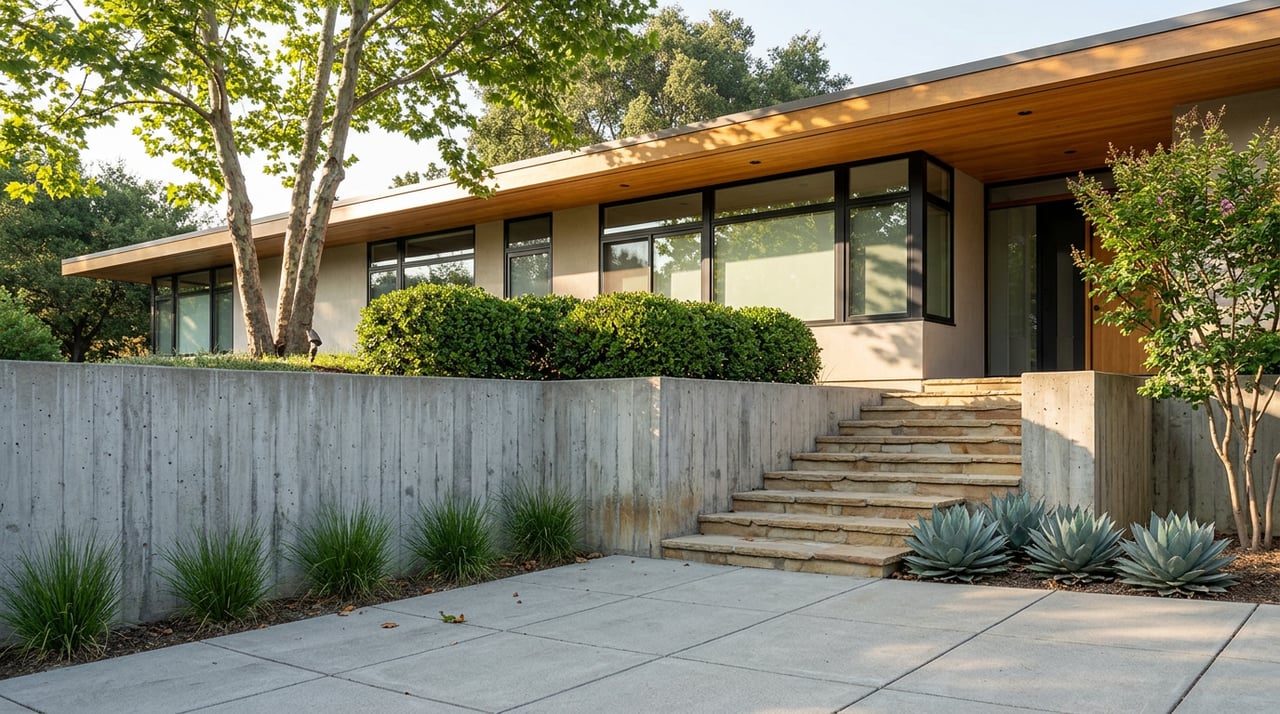
What sets the community apart isn't its age. It's how specific the covenants get about protecting what residents can see. According to reporting in the Claremont Courier, the association's rules require flat roofs across the hillside for one reason: so a neighbor's roofline never blocks the valley view from the home above it. The HOA's own Architectural Review Committee describes the community as a "stair-stepped hill," and its published guidance makes clear that any new construction, remodel, or even a solar panel installation has to be reviewed for whether it interferes with a neighboring property's sightline before it can be approved.
That is an unusually strong claim to make in California. According to LegalClarity, outside of a specific municipal ordinance or a recorded private covenant, state courts have established that no landowner has an automatic legal right to stop a neighbor from blocking a view. Most Claremont neighborhoods don't have anything like Claraboya's architectural authority at all. The ones that do typically limit it to setbacks and paint colors, not sightlines.
Where the Covenant Runs Out
The flat roofs and the architectural review only reach as far as private property lines. They have no authority over anything the city owns, and Mountain Avenue's Canary Island pines are city property, planted decades ago as street trees and maintained by Claremont's own landscape crews.
Those pines have been the subject of an active, multi-year debate. In January 2025 the City Council directed staff to develop a removal and replacement plan for the pines after residents raised concerns that ranged from root damage to blocked views. By late August 2025, the city was running a community survey and holding a public meeting at the Alexander Hughes Community Center to gather resident input on the trees' future. That fall, Claraboya resident Michael Hertel published a viewpoint in the Courier arguing the pines should come down, pointing to their size, their limb drop, and the public safety questions that come with mature trees on a residential street.
Then the process slowed. In February 2026, the council voted unanimously to stay the removal of all 207 city-owned pines pending further review. Two months later, Claraboya homeowner Richard Suter made a single, targeted request to remove one tree, backed by an arborist's structural notes; the council still denied it by a 4 to 1 vote.
None of that is an HOA matter. The Claraboya Homeowners Association can tell a resident what pitch to put on a new roof. It has no standing over what the City of Claremont plants, prunes, or preserves in the public right of way, which is precisely why the same neighborhood that wrote view protection into its architectural code has spent more than a year negotiating with City Hall over trees the HOA can't touch.
What the Premium Is Actually Paying For
Public valuation trackers put typical Claraboya home values somewhere between $1.4 million and $1.6 million through the first half of 2026, with active listings this fall priced from roughly $1.5 million to just under $1.9 million. Citywide Claremont figures, by comparison, were running closer to $1.0 million to $1.05 million across July and August 2026.
| Claraboya | Claremont citywide | |
|---|---|---|
| Typical value range, 2026 | ~$1.4M to $1.6M | ~$1.0M to $1.05M |
| Governance | Active HOA since 1969, view-review architecture committee | Mostly no HOA |
| View protection scope | Private lots only | Not applicable |
That gap is real, and elevation and lot size explain a meaningful share of it. But part of what a buyer is paying for in Claraboya is the discipline the HOA imposes on private construction. That is worth something concrete, and it's rarer in Claremont than the marketing copy around hillside homes tends to suggest.
It is also worth being precise about what it isn't. It isn't a guarantee that the streetscape stays the same, and it isn't leverage over decisions the city makes about its own trees.
Before You Write an Offer
A few questions are worth asking before a Claraboya purchase closes, not because the answers are likely to be dealbreakers, but because they clarify exactly what protection you're buying:
- Ask for the current CC&Rs directly from Crown Property Management and confirm the flat-roof and view-review provisions are still active as written, not just historical language.
- Walk the lot and identify whether any part of the view depends on city-owned street trees or landscaping the HOA has no authority over.
- Ask whether any Architectural Review Committee applications are pending on neighboring lots that could affect your own sightline before or after closing.
- Request the HOA's current resale disclosure package.
A Few Direct Answers
Does buying in Claraboya guarantee a permanent view? No. It has no reach over city trees, utility work, or anything outside the neighborhood's private lots.
Could the pine tree situation change again? Yes. That decision sits entirely with the Claremont City Council, not the HOA, and council positions on the 207 city-owned pines have already shifted twice during the debate. Buyers should treat the current streetscape as a snapshot, not a fixed feature of the property.
Understanding exactly what a neighborhood's governing documents can and can't guarantee is the kind of detail that only shows up once you're deep in a specific transaction, which is where our team spends most of its time. If you're weighing a purchase in Claraboya or anywhere else in the foothills and want a clear read on what you're actually buying, Concierge Realty Group is glad to walk through it with you. Schedule a Consultation whenever you're ready to talk specifics.
This article is general information, not legal, tax or financial advice. Consult a qualified professional about your situation.